

Importance vs Access: The Artist Mistake The Kills Curiosity
Say less. Place it better.
THE SHIFT
Most artists think people aren't responding because the work isn't important enough.
That's rarely the problem.
The problem is access.
You know why the work matters.
You lived it.
You built it.
You spent months or years inside it.
Your audience didn't.
They arrive with none of your context.
None of your history.
None of your emotional investment.
And that's where most artists lose people.
They start with importance.
When they should start with access.
Because people can't appreciate significance until they have somewhere to stand.
First they enter.
Then they care.
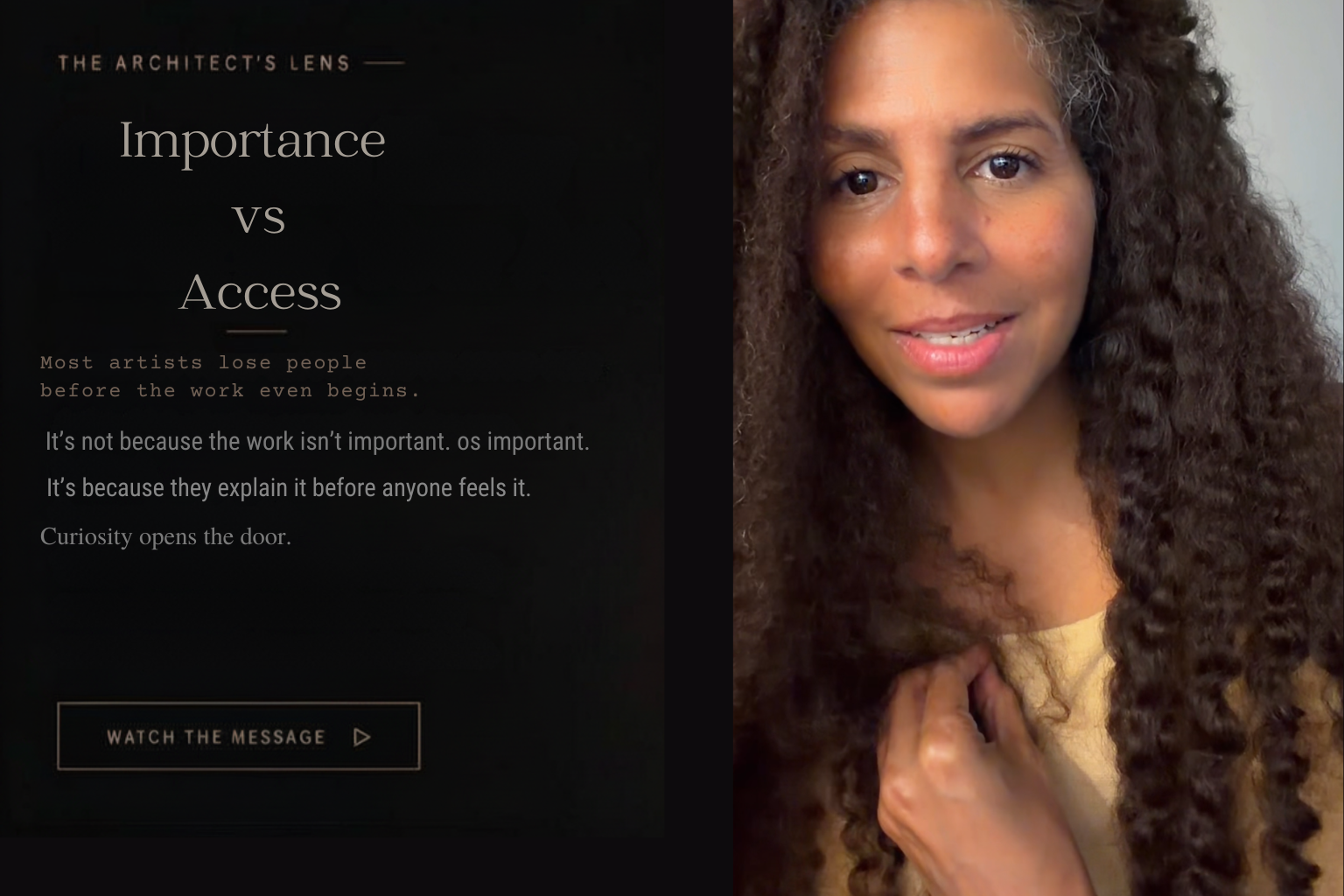
Importance vs Access
Short Video
WHAT MOST ARTISTS DO (WRONG)
They tell people why the work matters.
They announce its importance.
They explain its depth.
They describe its meaning.
Example:
"This is one of the most important songs I've ever written."
Maybe it is.
But importance to you doesn't automatically create importance for them.
Or:
"This chapter contains the central idea of the entire story."
Now you're asking someone to care about something they haven't experienced yet.
You're asking for commitment before connection.
And most people leave.
Not because the work is weak.
Because they haven't found the doorway.
WHAT ACTUALLY WORKS (RIGHT)
They create access first.
They give people something they can immediately recognize.
Something they can feel before they understand.
Example:
"This is the moment she realizes the thing she spent years chasing may have never been missing."
Now there's tension.
Now there's curiosity.
Now someone wants to know more.
Or:
"He spent his whole life trying to become someone.
Then one day, there was nobody left to become."
You haven't explained anything.
But you've created access.
And access creates movement.
THE PRINCIPLE
Importance does not create connection.
Access creates connection.
People don't enter because you tell them something is meaningful.
They enter because something feels familiar.
A question.
A contradiction.
A moment.
A feeling they recognize before they can explain it.
This is why artist positioning, storytelling, audience engagement, emotional branding, and creative communication all begin in the same place:
Recognition.
Not explanation.
Not importance.
Recognition.
Because recognition is what allows people to enter.
And entry always comes before meaning.
WHY ARTISTS STRUGGLE WITH THIS
Because creators naturally communicate from the inside.
The audience experiences from the outside.
You know the entire world.
They know one sentence.
You know the ending.
They just arrived.
You know why the work matters.
They don't even know where they belong yet.
That's why over-explaining often hurts audience engagement.
The problem isn't that people don't care.
The problem is that they haven't entered.
EXAMPLES (MULTI-ARTIST)
Painter
Wrong:
"This collection explores the tension between memory and identity."
Right:
"Have you ever looked at an old photo and felt like you were staring at someone else?"
Photographer
Wrong:
"This series examines emotional distance in modern relationships."
Right:
"They spent every day together.
Neither of them felt seen."
Writer
Wrong:
"This novel explores self-discovery and personal transformation."
Right:
"What if the person you've been trying to become is the reason you feel lost?"
Music
Wrong:
"This concept album explores consciousness, identity, and perception."
Right:
"She thought she found something rare.
Years later, she realized she found something she never lost."
WHY THIS MATTERS FOR WORLD-BUILDING
Whether you're creating music, stories, films, photography, or a concept album, people enter through moments.
Not explanations.
The strongest world-building doesn't begin with lore.
It begins with recognition.
The strongest storytelling doesn't begin with meaning.
It begins with tension.
The strongest artist positioning doesn't begin with credentials.
It begins with a doorway.
That's what creates audience engagement.
That's what makes people care.
That's what gives your work gravity.
YOUR WORKSHEET
Step 1 — Find What You Think Is Important
Write the thing you usually tell people about your work.
Example:
"This song is about..."
"This project explores..."
"This story represents..."
My statement:
Step 2 — Find The Human Moment Underneath It
Ask:
What is the actual experience inside this?
What does someone feel?
Examples:
regret
uncertainty
longing
recognition
relief
confusion
My human moment:
Step 3 — Create Access
Turn the experience into a doorway.
Start with:
"Have you ever..."
"What if..."
"You know that feeling when..."
Example:
"What if the thing you were searching for was the thing making you search?"
Your line:
Step 4 — Test It
Ask:
Would someone feel something before they understand it?
Yes → Keep it.
No → Remove more explanation.
Access comes first.
Meaning comes later.
FINAL NOTE
Most artists aren't losing people because the work isn't powerful.
They're losing people because they're starting from importance instead of access.
The audience doesn't need the full explanation.
They need a way in.
Give them one thing that feels real.
One thing they recognize.
One doorway.
Let the meaning take care of itself.
Say less.
Place it better.
And watch what changes.
© KyeraWorld — kyera.world
Private circulation only