

Seen vs. Felt: Why Emotional Connection Matters More Than Visibility
Say less. Place it better.
Most creators focus on being seen.
The real shift happens when your work is felt.
That is the difference between content people scroll past and work people carry with them.
In a world flooded with content, visibility alone is no longer enough. The artists people remember are not always the loudest. They are the ones who create emotional recognition instantly.
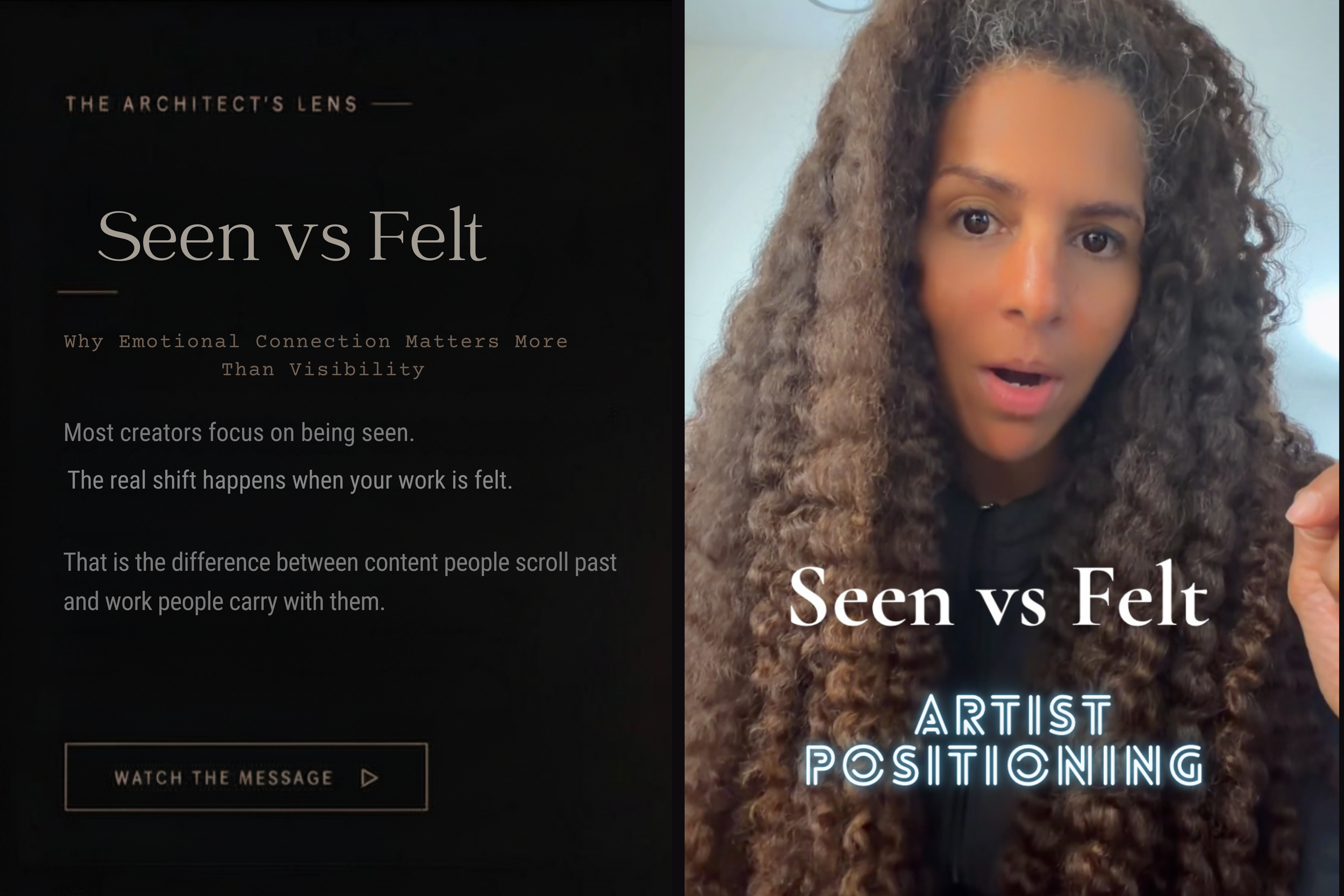
Seen vs. Felt
Short Video
The Shift in Artist Branding
Most artists believe attention comes from exposure.
It doesn’t.
Lasting audience connection comes from emotional involvement.
People rarely leave because they missed your post.
They leave because nothing inside the work reached them.
Seeing is passive.
Feeling creates movement.
And movement creates memory.
What Most Artists Get Wrong About Marketing
A large amount of music marketing, artist branding, and creative promotion fails for one reason:
It asks for attention before creating emotional tension.
Examples:
“New single out now.”
“My latest visual series is live.”
“Check out my new concept project.”
This creates visibility.
But visibility without sensation disappears instantly.
There is no emotional entry point.
No curiosity.
No psychological pull.
The audience is asked to care before they feel anything.
What Actually Creates Audience Connection
Strong artist positioning and creative branding create feeling first.
Not after the click.
Not after the explanation.
Before anything else.
Example:
“This is what it feels like when the internal noise stops… and you mistake that for becoming something more.”
Now the audience experiences something immediately.
Before analysis.
Before logic.
Before deciding whether they care.
They feel it first.
That is the moment attention changes into involvement.
The Core Principle of Artist Positioning
People do not commit because they saw something.
They commit because something inside them responded emotionally.
Feeling is not decoration.
It is not enhancement.
It is the entry point.
If nothing is emotionally felt within the first few seconds, audience attention disappears quickly.
This applies to:
music marketing
artist development
independent musicians
photography portfolios
film promotion
cinematic storytelling
storytelling
visual art branding
creative worldbuilding
social media strategy for artists
audience psychology
Examples of Emotional Positioning Across Different Art Forms
Painter
Weak Positioning
“This piece explores emotional fragmentation through color.”
Strong Positioning
“Ever felt like you were holding yourself together just to appear whole?”
Photographer
Weak Positioning
“A visual series about solitude in urban life.”
Strong Positioning
“There’s a kind of loneliness that only appears around other people.”
Writer
Weak Positioning
“A story about identity and internal conflict.”
Strong Positioning
“What if the version of you everyone knows isn’t the real one?”
Music Marketing / Conceptual Storytelling
Weak Positioning
“The Wasn’t explores identity, perception, and control through a conceptual narrative.”
Strong Positioning
“This is what it feels like when everything goes quiet… and you think it means you’ve become something more.”
Artist Positioning Worksheet
Step 1 — Identify the Emotional Core
Do not ask:
“What is my work about?”
Ask:
“What does my work do to someone emotionally?”
Examples:
uneasy stillness
false clarity
longing without resolution
emotional displacement
being misunderstood
losing something unnamed
My work feels like:
Step 2 — Translate It Into a Felt Moment
Use emotional entry language:
“This is what it feels like when…”
“You know that moment when…”
“What happens when…”
Example:
“You know that moment when everything finally goes quiet and it feels like something inside reality shifted?”
Your line:
Step 3 — Remove Explanation
Delete anything that:
explains the concept
labels the meaning
requires intellectual interpretation first
Keep only what lands immediately.
If people need to process it before they feel it, the positioning is too distant.
Do not make it clearer.
Make it sharper.
Step 4 — Test the Emotional Response
Ask:
Does this create emotional reaction within 3 seconds?
If yes:
It is ready.
If no:
Simplify again.
Attention follows feeling.
Final Thought on Creative Positioning
You do not need more visibility.
You need work that reaches people emotionally.
Because once something is genuinely felt, attention follows naturally.
Say less.
Place it better.
And watch what changes.
© KyeraWorld
For artists building worlds, not just content.